
Information updated: September 23, 2026
UPI has become one of the easiest ways to pay in India. From buying groceries to paying bills and sending money to family, millions of people use UPI every day.
But there is an important UPI change in 2026 that users and businesses should understand.
From October 15, 2026, a new Merchant Discount Rate (MDR) framework will apply to certain higher-value person-to-merchant (P2M) UPI transactions. The standard MDR is 0.4% for eligible merchant transactions above ₹2,000, while consumers will not be charged a transaction fee for making those payments. The government has also clarified that person-to-person UPI transfers remain free.
This does not mean that UPI is becoming a paid service for ordinary users.
The important distinction is between the customer making a payment and the merchant accepting a payment.
Let’s understand the new UPI rules in simple terms.
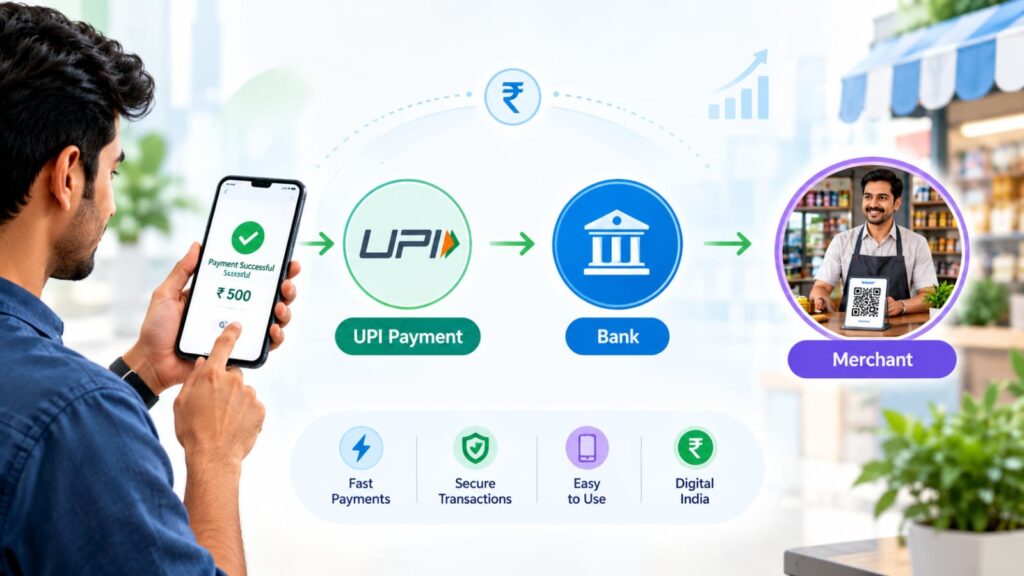
UPI Changes 2026: What Is Actually Changing?
The biggest change is the introduction of an MDR on certain merchant payments.
MDR, or Merchant Discount Rate, is a fee associated with accepting a digital payment. Under the new framework, eligible merchants will pay the applicable MDR to the payment ecosystem rather than the customer being charged directly.
According to the Ministry of Finance, UPI will continue to be free for:
- Person-to-person (P2P) transactions.
- Merchant payments up to ₹2,000.
- Transactions covered by the zero-MDR framework for small merchants.
- Consumers making UPI payments generally.
The government says approximately 96% of P2M transactions will remain unaffected by the new MDR framework.
When Does the New MDR Start?
The new framework takes effect on October 15, 2026.
That date is important for businesses because transactions covered by the new framework will start being processed under the revised MDR structure from then.
What Is the New UPI Merchant Fee?
From October 15, 2026, a new Merchant Discount Rate (MDR) will apply to certain Person-to-Merchant (P2M) UPI transactions above ₹2,000. The standard MDR is 0.4%, with the charge capped at ₹300 per transaction for transactions of ₹75,000 and above. The MDR is paid within the merchant payment ecosystem; it is not a separate UPI transaction fee charged to consumers. The Ministry of Finance says customers will continue to use UPI without transaction charges.
For example, if a customer makes a ₹5,000 eligible merchant payment through UPI, the standard 0.4% MDR would be ₹20. The customer still pays ₹5,000; the MDR is a merchant-side payment-processing cost.
| Transaction type | Treatment under the new framework |
|---|---|
| Person-to-person (P2P) UPI | Free |
| Merchant payment up to ₹2,000 | Zero MDR |
| Eligible merchant payment above ₹2,000 | 0.4% MDR |
| Eligible payment of ₹75,000 or more | 0.4% MDR, capped at ₹300 |
| Eligible small merchants under the zero-MDR framework | Exempt |
| Customer transaction fee | No UPI transaction charge |
The government says payments to merchants up to ₹2,000 and transactions covered by the zero-MDR framework for small merchants will remain free. It estimates that approximately 96% of P2M transactions will remain unaffected.
Important: The 0.4% rate is the standard rate. Certain categories have separate treatment under the framework, including specified essential-sector and capital-market transactions. Businesses should therefore check the applicable category and their payment provider’s settlement terms rather than assuming that every transaction above ₹2,000 will be charged at exactly 0.4%.
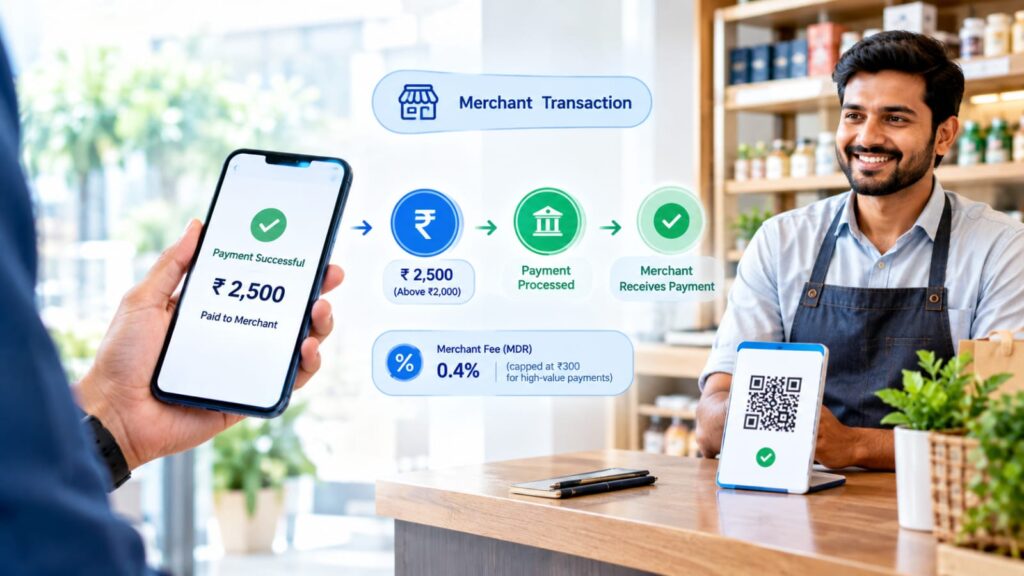
How the New UPI Merchant Fee Works
Imagine you buy a product from a larger merchant for ₹5,000 using UPI.
Under the standard 0.4% MDR:
₹5,000 × 0.4% = ₹20
The ₹20 is the merchant-side MDR.
The customer still pays ₹5,000, rather than ₹5,020, as a UPI transaction fee.
This distinction is important because a merchant’s payment-processing cost and a customer’s UPI transaction charge are not the same thing.
The Finance Ministry has specifically stated that MDR is not a tax collected by the government or NPCI. It is distributed among participants in the payments ecosystem, including banks and payment application providers.
Who Will Be Affected?
Impact on UPI Users
For most people, there is little practical change when using UPI.
You can continue using UPI for:
- Sending money to another person.
- Paying a shop.
- Paying a merchant for an amount up to ₹2,000.
- Making other transactions that remain outside the MDR framework.
Most importantly, customers are not supposed to pay the new MDR as a separate UPI transaction charge.
The government’s September 15 clarification says P2P transactions remain completely free, while payments to merchants up to ₹2,000 and transactions covered under the zero-MDR framework also remain free.
Impact on Small Merchants
Small businesses are an important part of the new framework.
The government has said transactions covered by the zero-MDR framework for small merchants will remain free. Therefore, a small shop or local business may not face the same MDR treatment as a larger merchant.
Businesses should not assume that simply accepting UPI automatically means paying 0.4% on every transaction.
The merchant’s classification, transaction type, and applicable framework matter.
Impact on Larger Businesses
The effect is more relevant for businesses that regularly receive larger-value UPI payments.
For example, businesses selling:
- Electronics
- Furniture
- Vehicles and related products
- High-value services
- Other products with transactions above ₹2,000
may need to account for MDR when calculating payment-processing costs.
For a business receiving thousands of higher-value UPI payments, even a small percentage fee can become a noticeable operating expense.
Real-Life Examples of the New UPI Fee
Here are some simple examples using the standard 0.4% MDR.
| Customer payment | 0.4% MDR calculation | Merchant MDR |
|---|---|---|
| ₹1,000 | Not applicable under the standard >₹2,000 threshold | ₹0 |
| ₹2,000 | Not applicable under the standard >₹2,000 threshold | ₹0 |
| ₹3,000 | ₹3,000 × 0.4% | ₹12 |
| ₹5,000 | ₹5,000 × 0.4% | ₹20 |
| ₹10,000 | ₹10,000 × 0.4% | ₹40 |
| ₹50,000 | ₹50,000 × 0.4% | ₹200 |
| ₹75,000 | 0.4% would be ₹300. | ₹300 |
These examples illustrate the standard rate and are not a substitute for the merchant’s actual settlement statement.
Example: A ₹1,500 Grocery Payment
Suppose a customer buys groceries worth ₹1,500.
The transaction is below the ₹2,000 threshold, so the standard new MDR does not apply.
Example: A ₹5,000 Electronics Purchase
A customer buys a ₹5,000 product.
At 0.4%, the merchant-side MDR would be ₹20.
The customer does not add ₹20 simply because they used UPI.
Example: Sending ₹10,000 to a Friend
Suppose you transfer ₹10,000 to a friend.
This is a P2P transaction, not a merchant payment. The government’s September 2026 clarification says P2P UPI transactions remain free irrespective of the amount.
Advantages of the New UPI Fee Structure
There are several stated reasons behind the change.
Keeps Small-Value Payments Free
The framework continues to protect everyday low-value merchant payments, including payments up to ₹2,000.
This is important because many routine UPI payments fall into this category.
Customers Continue to Use UPI Without a Transaction Fee
The government has maintained that customers will not face a UPI transaction charge under the new MDR framework.
3. Creates a Revenue Stream for the Payment Ecosystem
The MDR is intended to provide financial support for participants involved in operating and expanding the UPI ecosystem.
The Finance Ministry describes the broader policy objective as supporting the long-term sustainability, technological development, and resilience of UPI.
4. Businesses Can Budget for the Cost
For affected businesses, the fee is relatively straightforward to calculate.
A company can estimate its payment-processing expense based on the value and number of eligible transactions.
Disadvantages or Risks
The change also creates practical concerns for businesses.
Higher Payment-Processing Costs
Businesses receiving many high-value UPI payments will have an additional cost to consider.
This may matter particularly for businesses operating on relatively low margins.
Possible Confusion Among Customers
Customers may see news about “UPI charges” and assume that every UPI payment will become paid.
That is incorrect.
The new MDR is targeted at specified merchant transactions, while P2P transactions remain free and most P2M transactions remain unaffected.
Businesses Need to Understand Their Merchant Category
The applicable MDR can depend on transaction and merchant classification.
Therefore, businesses should not calculate their costs solely from the headline 0.4% figure.
Payment Costs May Become a Business Planning Issue
Businesses that accept large digital payments should include payment-processing charges when reviewing their operating expenses.
Whether a business changes prices, absorbs the cost, or adjusts its payment strategy is a commercial decision and depends on its own circumstances.
What Users and Businesses Should Know
For ordinary UPI users, the main message is simple:
You do not suddenly have to pay a UPI fee every time you scan a QR code.
P2P transfers remain free, and merchant payments up to ₹2,000 remain free under the announced framework.
For businesses, the situation is different.
If your business accepts eligible UPI payments above ₹2,000, you should understand how your bank or payment service provider will implement the new MDR.
It is also worth checking how the fee appears on settlement reports and invoices.
What to Check Before Taking Action
Businesses should consider checking the following before October 15, 2026:
- Merchant classification: Confirm whether your business qualifies for a zero-MDR small-merchant framework.
- Transaction category: Check which types of UPI payments are covered.
- Settlement statement: Understand how MDR will appear in your settlement records.
- Rate: Confirm the applicable MDR with your acquiring bank or payment provider.
- Cap: Check how the ₹300 cap applies to eligible transactions.
- Customer communication: Do not automatically assume that the MDR can be added as a separate UPI fee to the customer’s bill.
- Accounting: Make sure payment-processing expenses are recorded correctly.
- Official updates: Check NPCI, RBI, and Ministry of Finance communications if the rules or implementation details change.
The government has said the MDR should not be treated as a charge imposed directly on UPI users.
UPI Changes 2026: What This Means in Simple Terms
The easiest way to understand the change is
UPI is not becoming a paid service for ordinary users.
Instead, India is introducing a merchant-side MDR for specified higher-value P2M transactions.
From October 15, 2026:
- P2P UPI remains free.
- Merchant payments up to ₹2,000 remain free.
- Eligible higher-value merchant payments can attract 0.4% MDR.
- The standard MDR has a ₹300 per-transaction cap.
- Eligible small merchants covered by the zero-MDR framework remain exempt.
- The customer is not supposed to be charged the MDR as a separate UPI transaction fee.
The change therefore matters much more to business payment costs than to the everyday experience of most UPI users.
Frequently Asked Questions (FAQs)
1. Is UPI becoming chargeable in 2026?
No. UPI is not becoming a paid service for ordinary users. Under the announced framework, customers are not charged a separate UPI transaction fee for eligible merchant payments.
2. What is the new UPI merchant fee in 2026?
From October 15, 2026, a standard 0.4% Merchant Discount Rate (MDR) applies to certain eligible person-to-merchant (P2M) UPI transactions above ₹2,000.
3. Will I have to pay extra when I make a ₹5,000 UPI payment?
No separate UPI transaction fee is supposed to be charged to the customer under the new MDR framework. For an eligible ₹5,000 merchant payment, the standard 0.4% MDR would be ₹20, which is a merchant-side payment-processing cost.
4. Is sending money to friends through UPI still free?
Yes. Person-to-person (P2P) UPI transfers remain free under the announced September 2026 framework.
5. Will UPI payments below ₹2,000 have a merchant fee?
Merchant payments up to ₹2,000 remain under the zero-MDR treatment described in the announced framework.
6. Who will be affected by the new UPI MDR?
The change is mainly relevant to merchants receiving eligible higher-value UPI payments. The actual treatment can depend on the merchant and transaction category.
7. What is the maximum MDR for an eligible UPI transaction?
The standard MDR is 0.4%, with a ₹300 per-transaction cap for eligible transactions of ₹75,000 and above, subject to the applicable framework and category.
8. Do small businesses have to pay 0.4% MDR on every UPI payment?
Not necessarily. Eligible small merchants covered by the zero-MDR framework remain exempt. Businesses should confirm their classification and applicable treatment with their payment provider.
9. When will the new UPI MDR start?
The announced framework takes effect on October 15, 2026.
10. Where can businesses check the latest UPI rules?
Businesses should check the latest communications from the Ministry of Finance, RBI, NPCI, and their acquiring bank or payment service provider because implementation details can change.
Conclusion
The UPI changes in 2026 are mainly about how certain higher-value merchant payments are processed, not about making UPI a paid service for ordinary users.
From October 15, 2026, eligible merchant transactions above ₹2,000 may attract a standard 0.4% MDR, while P2P transfers and merchant payments up to ₹2,000 remain under the announced free or zero-MDR framework.
Pingback: WhatsApp Scam 2026: How to Identify Dangerous Files