
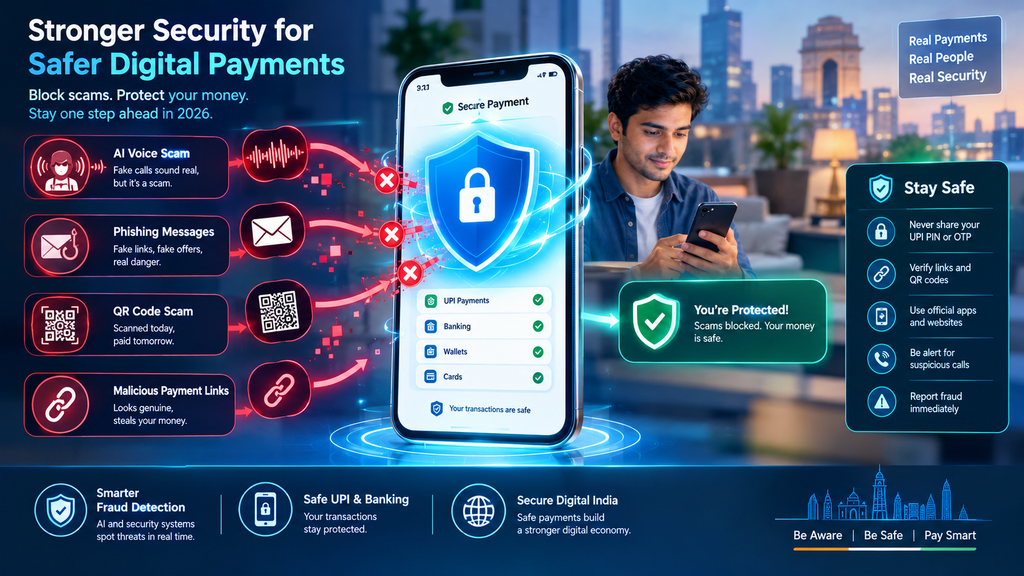
Digital payments have made everyday transactions faster and easier. In India, people regularly use UPI, QR codes, mobile banking, cards and payment apps for everything from groceries to online shopping.
But the same convenience can also be misused by scammers.
In 2026, many payment scams are not based on breaking into a bank’s system. Instead, criminals try to trick users into approving a payment, sharing sensitive information, installing malicious software or sending money themselves.
Official guidance from the Reserve Bank of India (RBI), NPCI and CERT- In repeatedly warns users not to share OTPs, passwords or UPI PINs and to verify unexpected payment requests.
This guide explains 10 online payment scams you should watch for in 2026, how they work, and what you can do if you encounter one.
What Are Online Payment Scams?
Online payment scams are fraudulent schemes designed to make a person or business lose money through a digital payment system.
They can involve:
- UPI payments
- QR codes
- Debit or credit cards
- Internet banking
- Mobile wallets
- Fake shopping websites
- Fraudulent payment links
- Fake customer-support numbers
- Malicious mobile applications
- Social media and messaging apps
A key point is that many scams rely on social engineering rather than a technical attack.
For example, a scammer may pretend to be a bank employee, customer, delivery agent, friend, government official or online seller.
The goal is to create enough trust, fear or urgency that the victim acts without checking.
What Has Changed in Online Payment Scams in 2026?
The basic tricks behind payment fraud are not completely new. However, scammers can combine older methods with newer technology.
One important development is the increasing use of AI-generated or highly convincing impersonation content. CERT-In has warned users to be cautious about AI-generated phishing, fake websites, deepfake-style impersonation and convincing urgent requests involving money or sensitive information.
Another continuing concern is malicious mobile software. CERT-In advises users not to install APK files received through WhatsApp, SMS, Telegram or random websites and recommends downloading apps through official app stores.
So, in 2026, users should not rely only on appearance.
A message can look professional.
A caller can sound convincing.
A payment page can look genuine.
Always verify independently before making a payment.
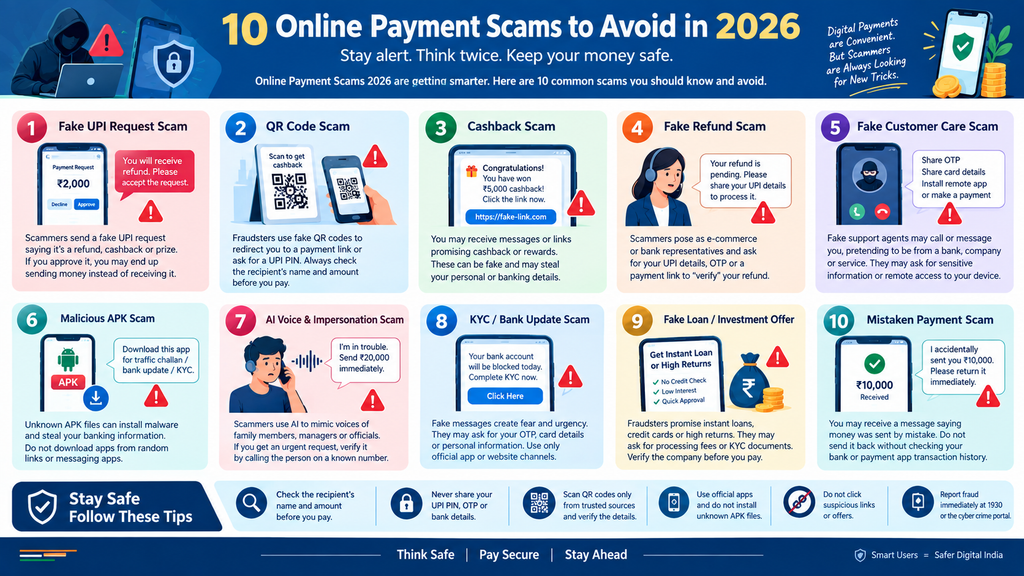
10 Online Payment Scams You Must Avoid in 2026
Fake UPI Payment Request Scam
A scammer may send a UPI payment request and tell you that it is a refund, cashback, prize or money transfer.
The victim may think they are receiving money when they are actually being asked to approve a payment.
How it works
The scammer might say:
“Please accept this request to receive your refund.”
But approving the request and entering the UPI PIN can authorise money leaving your account.
NPCI specifically warns that entering a UPI PIN after scanning a QR code is associated with making a payment, not receiving money.
Stay safe.
- Check whether the transaction says ‘Pay’ or ‘Receive’.
- Never enter your UPI PIN simply to receive money.
- Do not approve unexpected collect/payment requests.
QR Code Payment Scam
QR codes are convenient, but scammers can use them to redirect users toward fraudulent payments.
A scammer may say:
- “Scan this QR to receive your refund.”
- “Scan this QR for cashback.”
- “Scan this code to verify your account.”
- “Scan this to receive your payment.”
The important rule is simple:
Scanning a QR code does not automatically mean you are receiving money.
Before approving a payment, check the recipient’s name and the amount displayed in your payment app. CERT-In also advises users to verify the banking name before making payments through QR codes.
Fake Cashback and Reward Scam
You may receive a message saying:
“Congratulations! You have received ₹5,000 cashback.”
The message may contain a link or QR code.
The scammer then asks you to:
- Open a link.
- Enter bank details.
- Share an OTP.
- Approve a UPI request.
- Install an app.
NPCI lists fake cashback links among payment-fraud patterns users should watch for.
Red flag
If you have to pay money or enter your UPI PIN to receive cashback, stop and verify the offer through the official app or website.
Fake Refund Scam
This scam often targets online shoppers.
Someone may claim to be from an e-commerce company and say:
“Your refund is pending. We need to verify your bank account.”
They may send a payment link or ask you to approve a UPI request.
The scammer’s objective is to make the victim authorise a payment or disclose sensitive information.
How to protect yourself
Do not use a phone number supplied by the caller.
Instead:
- Open the shopping app yourself.
- Check your order history.
- Check the refund status.
- Contact customer support through the official application or website.
RBI advises customers to use verified official channels rather than relying on unknown contacts for banking-related services.
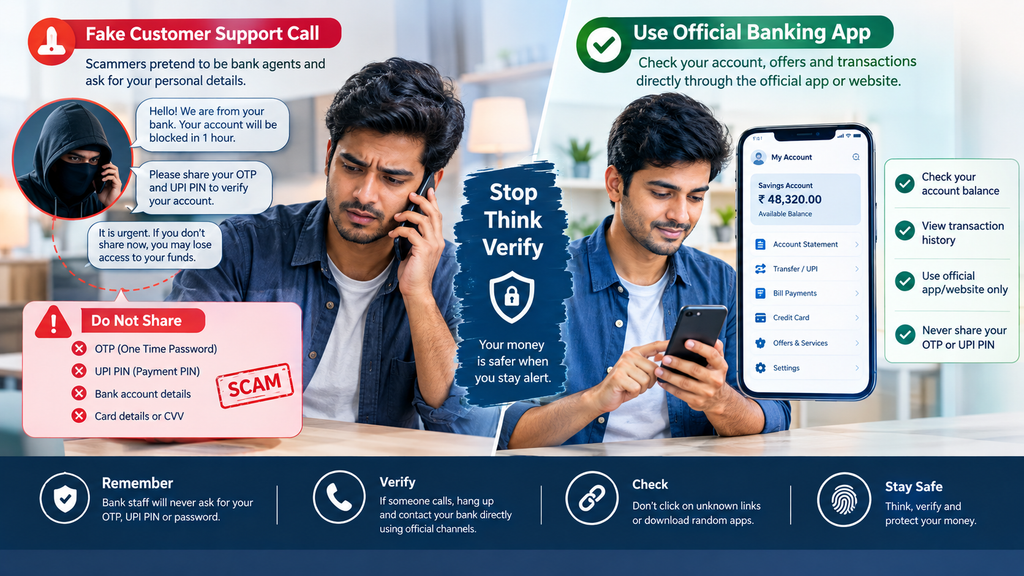
Fake Customer Care Payment Scam
Searching for customer-care numbers on the internet can sometimes lead users to fraudulent numbers or pages.
A scammer pretending to be customer support may ask you to:
- Share OTPs.
- Share card details.
- Reveal your UPI PIN.
- Install remote-access software.
- Transfer a “verification” amount.
CERT-In advises users to verify links and organisations independently and warns against granting strangers remote access to devices.
Safer method
Open the company’s official app or type its official website address yourself.
Do not blindly trust a customer-care number found in a social media comment or random search result.
Malicious APK and Payment-Stealing App Scam
This is particularly dangerous for Android users.
A scammer may send an APK through WhatsApp, SMS or Telegram and claim it is:
- A traffic-challan app
- A courier-tracking app
- A bank update
- A KYC application
- A payment verification app
- A government service app
Installing an unknown APK can expose the device to malware.
CERT-In specifically advises users not to install APKs received through WhatsApp, SMS, Telegram or random websites and recommends official app stores.
Rule to remember
Do not install an APK just because someone says it is urgent.
If you receive an official-looking message, independently open the relevant government, bank or company website.
AI Voice and Impersonation Payment Scam
AI can make impersonation scams more convincing.
A scammer may pretend to be:
- A family member
- A manager
- A business customer
- A bank representative
- A government official
The caller may create an emergency and ask for immediate payment.
For example:
“My phone is not working. Send ₹20,000 immediately.”
The voice may sound familiar, but that does not prove the caller is genuine.
CERT-In has specifically advised caution around AI-generated deepfakes and highly convincing impersonation attempts involving financial transactions.
Use a verification step.
Call the person using a known phone number, not the number provided by the caller.
For large payments, independently verify the request before transferring money.
Fake KYC, Bank or SIM Update Scam
A message may say:
“Your bank account will be blocked today.”
Or:
“Complete KYC immediately.”
The victim is directed to a fake website or asked to share an OTP or personal information.
These scams exploit fear and urgency.
RBI advises customers not to share sensitive banking credentials, OTPs or PINs and to use trusted banking channels.
Warning signs
Be careful when a message:
- Threatens immediate account closure.
- Uses an unfamiliar link.
- Requests OTPs through a caller.
- Requests card or banking credentials.
- Demands payment to “activate” an account.
Fake Loan, Credit Card or Investment Payment Scam
Fraudsters may advertise instant loans, credit cards or investment opportunities through social media, messages or websites.
They may request:
- Processing fees
- Verification charges
- Insurance fees
- Security deposits
- KYC documents
RBI has previously warned about unauthorised digital lending platforms and advises people to verify the credentials of entities offering loans online or through mobile apps.
CERT-In also lists loan/card scams and investment scams among online scam patterns.
Stay safe.
Never send money simply because someone promises guaranteed financial returns or an instant loan.
Verify the organisation through its official and regulatory channels before sharing documents or making payments.
“Mistaken Payment” or “Send It Back” Scam
Imagine receiving a message:
“I accidentally sent ₹10,000 to your account. Please return it immediately.”
The sender may provide a screenshot as proof.
CERT-In describes mistaken-money-transfer scams where criminals claim that money was accidentally transferred and pressure the recipient to send money back. Fake transaction evidence may be used to make the story appear genuine.
What should you do?
Do not rely on screenshots.
Check your actual bank or payment app transaction history.
If you genuinely receive an unexpected payment, contact your bank or payment provider and follow its instructions rather than sending money to a different account under pressure.
How These Payment Scams Usually Work
Most scams follow a similar pattern:
| Step | What the scammer does |
|---|---|
| 1. Contact | Sends a call, SMS, WhatsApp message, email or social-media message |
| 2. Trust | Pretends to be a bank, company, friend, seller or official |
| 3. Pressure | Creates fear, urgency, excitement or confusion |
| 4. Request | Asks for a payment, OTP, PIN, link click or app installation |
| 5. Transaction | The victim approves the payment or gives sensitive information. |
| 6. Disappearance | The scammer blocks the victim or stops responding. |
This is why slowing down is one of the simplest protections.
Who Is Most Likely to Be Targeted?
Online payment scams can affect almost anyone who uses digital payments.
Scammers may target:
- Students
- Senior citizens
- Online shoppers
- Small-business owners
- Freelancers
- Job seekers
- Online sellers
- Digital banking users
- People using UPI regularly
Businesses can also face payment fraud when employees receive fake supplier invoices, altered bank details or urgent payment requests.
For businesses, payment verification should be part of the normal approval process.
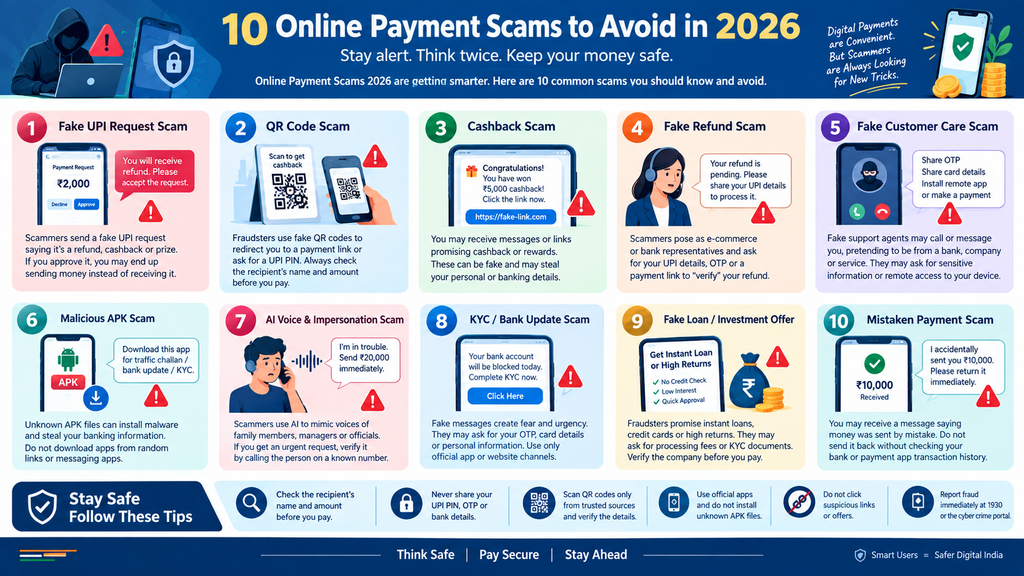
Real-Life Examples: How a Scam Can Look
The following are illustrative examples, not claims about specific individual cases.
Example 1: Fake refund
A customer receives a call claiming to be from an online store.
The caller says the customer has a ₹2,000 refund and sends a UPI request.
The customer approves it, thinking the money is coming in.
Risk: The customer may actually have authorised a payment.
Example 2: Fake Challan APK
A person receives a message saying that an unpaid traffic challan requires immediate payment and is asked to install an APK.
CERT-In has warned about malicious traffic-challan APK campaigns and advises users to verify challans through official government channels.
Example 3: AI voice request
Someone receives a call that sounds like a relative asking for urgent money.
Instead of transferring immediately, the person calls the relative’s saved number separately.
That independent verification can prevent an impersonation scam.
Benefits of Digital Payments — When Used Safely
Digital payments remain useful because they can provide:
- Convenient transactions
- Fast payments
- Digital transaction records
- Reduced need to carry cash
- Easy bill and merchant payments
- Access to banking services through mobile devices
NPCI notes convenience, speed and security among the advantages of digital payments.
The important point is that payment technology itself should not be confused with the social-engineering scams surrounding it.
A secure payment system can still be misused when a user is tricked into authorising a fraudulent transaction.
Risks and Things to Be Careful About
Watch for these warning signs:
Unexpected urgency
“Pay within 10 minutes or your account will be blocked.”
Requests for secret information
Never share your:
- UPI PIN
- OTP
- Password
- CVV
- Banking password
RBI explicitly advises customers not to share such credentials.
Unknown links
Do not click payment links simply because they look professional.
Unknown apps
Do not install APK files from messaging apps or random websites.
Payment to receive money
Be especially careful when someone says you must make a payment or enter your UPI PIN to receive money.
Pressure to keep the transaction secret
A legitimate business transaction should not normally require you to ignore your bank’s safety procedures.
What Users Should Do to Stay Safe
Stop before paying.
If a payment request is unexpected, pause.
Verify independently.
Use the official app, website or a trusted phone number.
Check the recipient.
Before approving a UPI payment, verify the displayed recipient and amount.
Never share your UPI PIN or OTP.
Your PIN and OTP are confidential.
Keep apps updated
Use genuine and updated software, as recommended by CERT-In.
Avoid unknown APK files.
Install apps from official app stores.
Monitor bank alerts.
Review SMS, email and transaction history for unusual activity. RBI recommends enabling transaction alerts and reporting unauthorised transactions promptly.
Report fraud immediately.
If you are a victim of financial cyber fraud in India, the government’s National Cyber Crime Reporting Portal advises victims to call 1930 for immediate reporting and also provides online reporting through its portal.
Do not wait for the scammer to respond before reporting.
What Businesses Should Do
Businesses should also create simple payment controls.
For example:
- Verify new supplier bank details through a separate channel.
- Require approval for large payments.
- Do not rely only on WhatsApp instructions.
- Check invoices against purchase orders.
- Keep accounting and payment access restricted.
- Review unusual payment requests.
- Train employees to identify phishing and impersonation attempts.
- Maintain records of payment confirmations.
For small businesses, even a basic two-person verification process can reduce the chance of an employee acting on a fraudulent payment instruction.
Key Takeaways
- Online payment scams often depend on tricking users, not simply hacking banks.
- Never share your UPI PIN, OTP, password or CVV with another person.
- You generally do not need a UPI PIN or OTP to receive money.
- Check the recipient’s name and amount before approving a payment.
- Do not install unknown APK files received through WhatsApp, SMS or Telegram.
- Be cautious of AI-generated voices, fake websites and convincing impersonation attempts.
- Do not trust screenshots as proof of payment.
- Verify refunds, KYC requests and customer-support contacts through official channels.
- Businesses should independently verify unusual payment and bank-detail changes.
- If you experience financial cyber fraud in India, report it immediately through 1930 and the National Cyber Crime Reporting Portal.
FAQs
1. What are online payment scams in 2026?
Online payment scams are fraudulent schemes designed to make people send money, approve unauthorised payments or reveal sensitive financial information. In 2026, traditional scams are increasingly combined with convincing phishing, impersonation, malicious apps and AI-generated content.
2. Can someone take money from my account just by sending a UPI request?
Receiving a payment request by itself does not automatically transfer money. A payment generally requires the user to authorise the transaction. NPCI has clarified that users must explicitly proceed with a payment and authorise it; users should therefore carefully review unexpected requests before approving them.
3. Do I need a UPI PIN to receive money?
Be very cautious if someone says you must enter your UPI PIN to receive money. NPCI’s fraud-awareness guidance says scanning a QR code and entering a UPI PIN is meant for making payments, not receiving them.
4. What should I do if I accidentally paid a scammer?
Contact your bank or payment provider immediately and report the transaction. In India, you should also report financial cyber fraud through 1930 and the National Cyber Crime Reporting Portal as soon as possible.
5. Are QR codes safe for making payments?
QR codes can be used for legitimate payments, but scammers can also use them to direct users toward fraudulent transactions. Always check the recipient’s name and payment amount before authorising the transaction.
6. Are APK files received through WhatsApp safe?
Do not assume they are safe. CERT-In specifically advises users not to install APK files received through WhatsApp, SMS, Telegram or random websites and recommends using official app stores.
7. How can I identify an AI voice payment scam?
Do not rely only on the person’s voice. If someone urgently asks for money, independently call them using a previously saved number or another trusted communication method. CERT-In has warned that AI-generated impersonation can make fraudulent requests highly convincing.
Conclusion
Online payments are now part of everyday life, but convenience should not mean rushing through a transaction.
The biggest warning sign in many payment scams is pressure. A scammer may tell you that your account will be blocked, your refund will expire, your relative is in trouble or a reward will disappear if you do not act immediately.
Take a pause.
Check the transaction.
Verify the person.
Use the official app or website.
Never share your UPI PIN or OTP.
In 2026, staying safe online is not about avoiding digital payments altogether. It is about understanding how payment scams work and developing the habit of verifying first, paying second.
If something feels urgent or unusual, stop the transaction and verify it independently.
Pingback: AI Shopping Scams 2026: Can AI Agents Really Be Trusted With Your Money? - TechFinance Global